New Build Roads and Sewers: What Does Adoption Mean and Who Pays?
Not every road, sewer, drain or open space on a new build estate is automatically adopted by a public authority. Learn what adoption means, what Section 38 and Section 104 agreements are and what buyers should check before reserving.
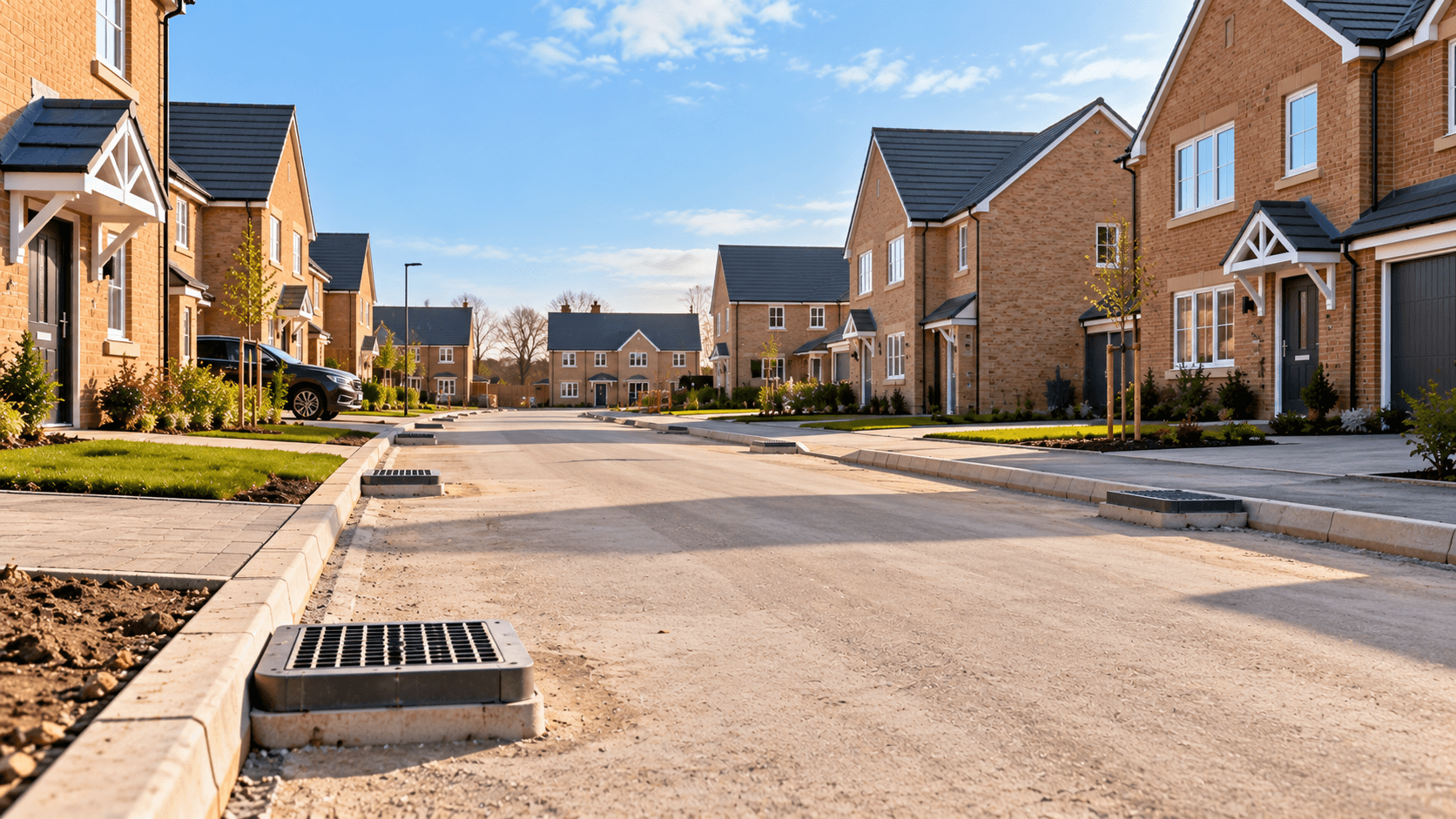
A new build estate can look finished long before responsibility for its roads, sewers, drainage and open spaces has been permanently settled.
Some infrastructure is intended to be adopted by a public authority or utility company once it meets the required standard. Other parts of the estate can remain privately managed, with homeowners contributing towards maintenance through an estate charge.
That distinction can affect both what you pay and who you contact when something goes wrong, so buyers should understand the proposed adoption arrangements before exchanging contracts.
What does 'adopted' mean on a new build estate?
Adoption means a public authority or statutory undertaker formally takes responsibility for maintaining particular infrastructure after the relevant requirements have been met.
For example, an adopted road is maintained by the highway authority rather than remaining a private road for which another party must arrange ongoing maintenance.
Adoption does not happen simply because residents have moved in. New roads or sewers may remain private for a period while construction continues, defects are corrected and final inspections take place.
What is an unadopted road?
An unadopted road has not been taken over by the highway authority for maintenance at public expense.
Responsibility during that period depends on the legal arrangements. The developer may still be responsible while the estate is being completed, or the road may ultimately remain private and be maintained through an estate-management structure.
Your conveyancer should explain what applies to the exact road serving your property.
What is a Section 38 agreement?
In England and Wales, Section 38 of the Highways Act 1980 is commonly used for agreements between a developer and the relevant highway authority under which a new road can be adopted once it is constructed to the required standard.
A recent parliamentary answer on road adoption explains that highway authorities will normally require a financial bond or other security where a Section 38 agreement is in place, helping protect against outstanding highway works if a developer fails to complete them.
The existence of an agreement does not mean adoption has already happened. Ask whether the road is adopted now, subject to an adoption agreement, or intended to remain private.
What is a Section 104 agreement?
Section 104 of the Water Industry Act 1991 provides a framework under which a sewerage undertaker can agree to adopt qualifying sewers, drains or sewage-disposal works in the future if the conditions of the agreement are met.
Ofwat describes a sewerage adoption agreement as an agreement under Section 104 for sewerage infrastructure constructed by a developer or customer to transfer into the ownership of the relevant sewerage company.
You can see the legislation on Section 104 of the Water Industry Act 1991.
Does every new build road have to be adopted?
No. Roads on a new housing development can remain private depending on the planning, design and legal arrangements.
The current position has attracted government attention because private estate management has become common on new developments. A 2025 government consultation in England examines ways to increase adoption of shared amenities and improve protections around privately managed estates.
You can read the current policy background in the government's consultation on private estate management arrangements.
If a road is private, who pays for it?
The legal documents determine who is responsible and how costs are collected.
On some developments, homeowners contribute through an estate-management charge that covers private roads alongside landscaping, lighting, drainage, play areas or other shared facilities.
Do not assume that council tax pays for maintenance of every road or landscaped area on a new build estate.
Our new build service charges and estate management fees guide explains the wider charging structure.
Do you still pay council tax on a privately managed estate?
Yes. Council tax and private estate charges are separate obligations.
Paying council tax does not automatically mean every road, green space or drainage feature outside your home is maintained by the council.
This is one reason buyers sometimes describe estate charges as paying twice, but legally the payments cover different obligations. What matters before purchase is knowing exactly what the private charge funds.
What about sewers and drains?
Different parts of a drainage system can have different ownership and maintenance arrangements.
Some sewers may be intended for adoption by the relevant sewerage company. Sustainable drainage systems, pumping stations and surface-water features can have other long-term maintenance arrangements.
Government planning guidance notes that sustainable drainage can potentially be maintained by organisations including a water company, local authority, lead local flood authority, community trust or private management company.
If drainage is privately maintained, ask who owns the assets, who pays for maintenance and how major future repairs would be funded.
What are SuDS?
Sustainable Drainage Systems, commonly shortened to SuDS, are features designed to manage surface water in a more controlled and sustainable way.
Attenuation ponds.
Swales.
Basins.
Permeable paving.
Rain gardens.
Underground storage systems.
Other features that slow, store or manage surface-water runoff.
A SuDS feature may look like landscaping but still perform an important drainage function. Buyers should not assume that ponds, planted basins or other drainage areas are simply decorative open space.
Can road adoption take years?
It can take time. Construction may still be continuing, remedial work may be required or the developer may need to satisfy technical conditions before the authority will adopt the road.
A long delay does not automatically prove something is wrong, but buyers should ask what stage the process has reached and whether a formal agreement is in place.
If you are buying in an early phase, the road outside your plot may remain within an active construction environment for some time after you move in.
What happens if the developer leaves before adoption?
The answer depends on whether formal agreements, bonds and other legal protections are in place.
Where a Section 38 road agreement includes appropriate security, the highway authority may have routes to address outstanding works. The exact position depends on the agreement and circumstances.
This is something your conveyancer can investigate before exchange. Ask for a clear explanation rather than relying on a sales-office statement that the roads 'will be adopted eventually'.
Can unadopted roads affect your mortgage or resale?
Potentially. Lenders and future buyers can ask about access rights, maintenance obligations and private charges.
A private road is not automatically unmortgageable, but the legal rights and maintenance arrangements need to be satisfactory.
When you eventually sell, your buyer's conveyancer may request information about the management company, charges and adoption position.
What should your conveyancer check?
Which roads serving the property are adopted today.
Whether any road is subject to a Section 38 or similar adoption agreement.
Whether sewers are subject to a Section 104 or other adoption arrangement.
Which drainage assets remain privately maintained.
What rights of access the property has.
Who owns communal infrastructure before and after adoption.
What estate-management charge applies.
How your share of costs is calculated.
Whether a management company is resident-controlled, developer-controlled or independently managed.
What happens if adoption is delayed or never takes place.
Questions to ask the sales team
Will the road outside my plot be adopted?
Is a Section 38 agreement already signed?
Which roads are intended to remain private?
Are the sewers adopted yet?
Is there a Section 104 agreement?
Who maintains the drainage ponds or SuDS?
What does the estate charge currently cover?
Which amenities could transfer to public maintenance later?
Will the estate charge reduce if some infrastructure is adopted?
Who manages the estate after the developer leaves?
The sales answer is a starting point. Your conveyancer should confirm the position using the legal documents.
How does this affect new build value?
There is no single rule that an adopted estate is automatically worth more than a privately managed estate.
Buyers should instead assess the size and predictability of the charge, the quality of the maintained areas, the legal protections and how responsibilities may change over time.
A well-managed private estate can still provide attractive shared spaces, while unclear or escalating obligations can create uncertainty.
Check the road and drainage physically too
Legal adoption is different from physical condition.
Even where a road is intended for adoption, buyers should notice unfinished surfacing, damaged kerbs, poor drainage or standing water and ask when outstanding works will be completed.
If water is collecting in your own garden, see our new build garden drainage problems guide.
Road and sewer adoption checklist
Identify adopted and private roads.
Ask about Section 38 agreements.
Ask about Section 104 agreements.
Check who maintains SuDS.
Confirm the current estate-management charge.
Understand what happens after adoption.
Check whether a bond or security exists where relevant.
Ask about remaining construction phases.
Have your conveyancer explain access and maintenance obligations.
Keep the management information with your completion documents.
The bottom line
Road and sewer adoption is easy to overlook because the infrastructure sits outside the front door, but it can affect annual charges, maintenance responsibility and future conveyancing.
Before reserving, find out which parts of the estate are intended for public adoption and which will remain private. Before exchange, have your conveyancer verify the agreements and explain what you will be required to pay for.
Combine these checks with our new build council tax guide and service charges and estate management fees guide to understand the full cost of living on the development.